Historical Calendar
In this article, I'll explain how you can get rid of the annoying “countdown” within history.
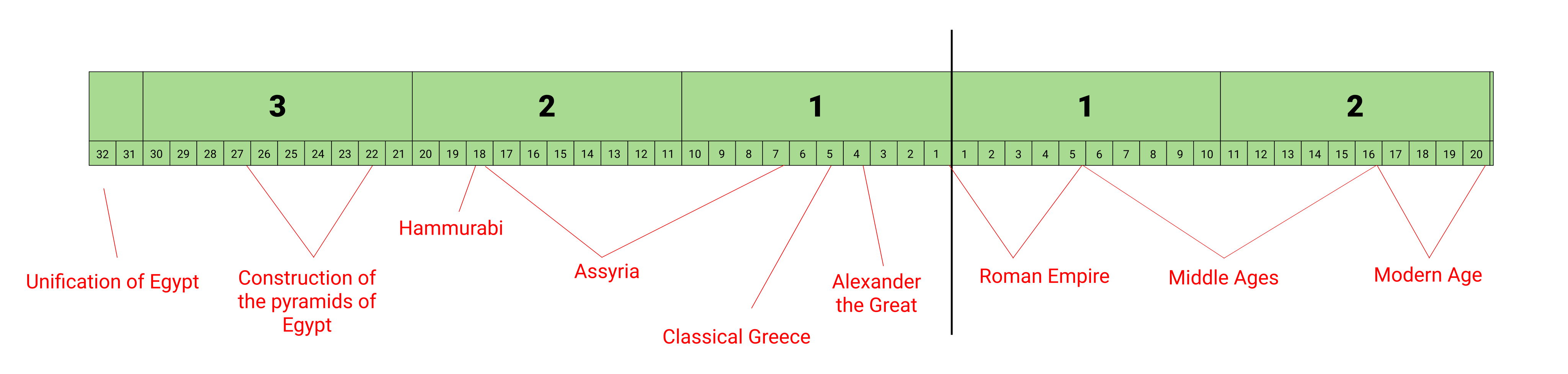
The problem with BC dates is that for more than half of all written history, the years are numbered backwards.
Is it a big problem?
You may think, "so what?" How big of a deal is this? Do we actually need to do anything about it?
If you think this way, notice that consciously or subconsciously you are making an assumption about how hard it would be to change the timeline. In general, the harder it is to solve a problem, the more likely you are to question if the problem even needs to be solved. And you are probably thinking that changing the timeline would necessitate a global calendar reform that would inconvenience everybody.
I'm not saying that the problem of counting BC dates backwards is so severe that we must inconvenience everybody just to solve it. No, my point is that there is another solution to the problem. A solution that doesn't require a calendar reform. A solution so simple that you don't need a big reason to try it.
You can just try it, because it doesn't cost you anything!
Warning: This is not for everybody
If you are not interested in ancient history, you won't be able to fully appreciate what I'm about to propose.
Worse, you may think I'm solving a problem that doesn't exist. In general, the less familiar you are with ancient history the less inconvenienced you are by BC dates.
Warning #2: You have to put in the effort
You don't judge a book by its cover. Likewise, you shouldn't judge what I propose here without putting in some required effort. Don't worry, the required effort is minuscule. It will take about 2 hours of your time. But if you don't put in any effort whatsoever, then, again, you won't be able to appreciate what I'm about to share with you.
Converting BC dates in electronic texts
Over the last few decades, we’ve accumulated a large amount of electronic text: websites, ebooks, Wikipedia. In all of these, BC dates can be converted into a different year numbering system.
This is not just an idea. I have developed software that does exactly this. Currently, it exists as a browser extension. Download it here. In the future, ebook readers and other reading apps will be able to do the same.
This doesn’t require rewriting historical sources or changing how they are stored. The conversion happens only at the presentation level — right after the page is loaded in your browser. The underlying texts remain unchanged, and the system simply transforms how dates are displayed on the fly.
You can also choose the starting point yourself, although I will explain below why I suggest using 10,000 BC as year one.
You can read about the technical solution in more detail in this white paper.
Converting dates in electronic texts is the only practical way to use an alternative year numbering system at scale.
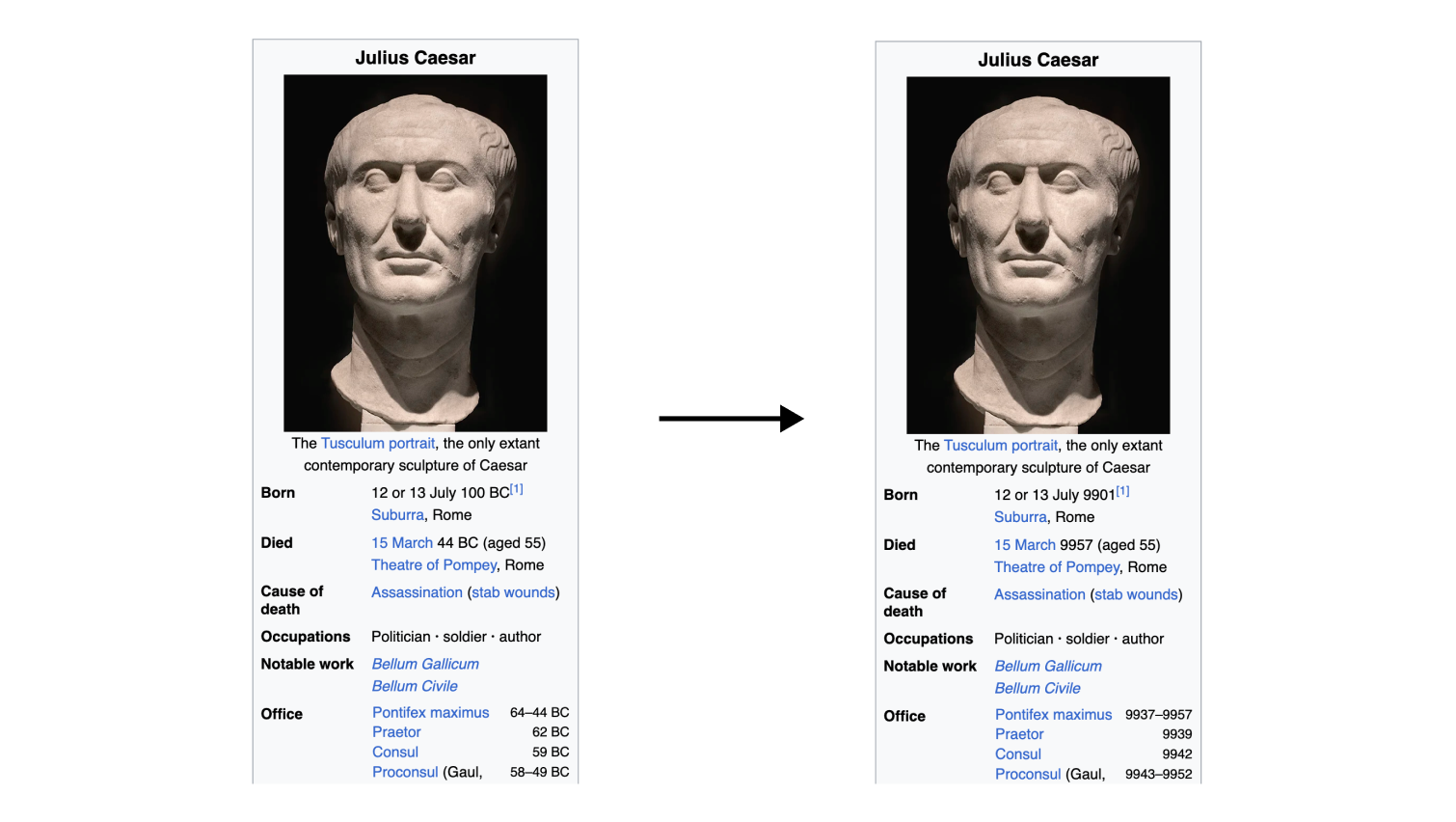
This is not about humanity adopting a new calendar. It’s not about reaching universal agreement on a starting point. It’s about what you can do individually, today, to see history differently.
You don’t have time to wait for a calendar reform that will never happen. You need a way to work with a different timeline now.
There is one caveat
While we can convert BC dates to any other timeline, we can't do the same with AD dates for technical reasons. The reasons are explained in the white paper. So, the resulting timeline you'd use may look like this:
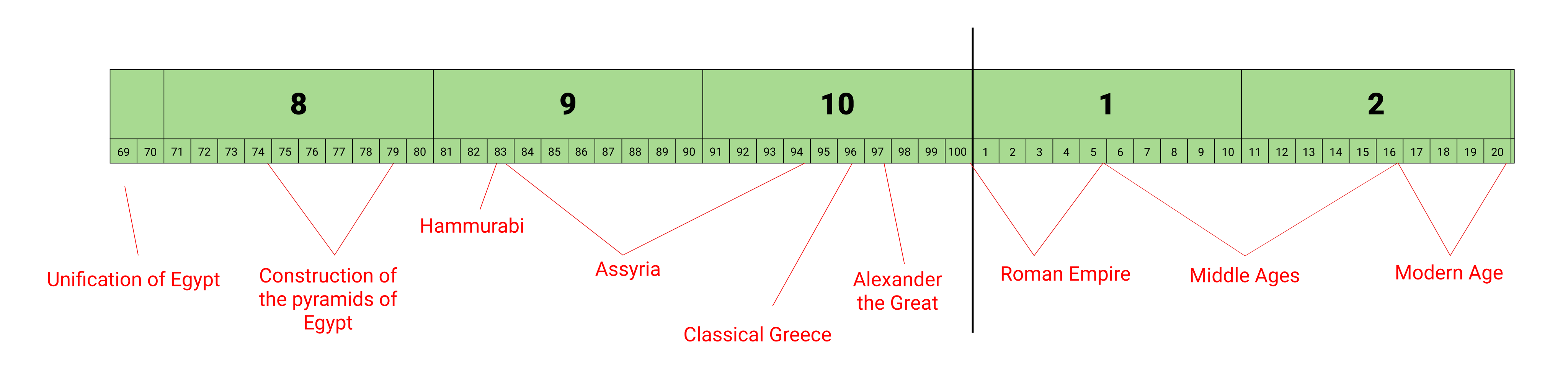
It's as if the year count restarts at the beginning of the Common Era. One way to look at it is to realize that it's still better than counting years of history backwards. But I like to think that in the future, people will be smart enough to use a modular system that restarts the count every 10,000 years.

Why start at 10,000 BC?
There is a simple consideration nobody has contemplated, simply because nobody has tried using an alternative year numbering system. You see, when you convert dates in electronic texts, you don't just convert years, you also have to convert centuries and millennia. So what, you ask? Think about it.
If you take the timelines you see above, you can say that the 2nd century BC converts to the 99th century in the alternative system. And the 3rd millennium BC converts to the 8th millennium in the alternative system. Such conversions are only possible because the timelines are aligned. Basically, we are reusing the same centuries and millennia we have in the Christian timeline.
That means you can start your count only at specific points on the timeline which are 1000 years apart. Examples are:
3000 BC, 4000 BC, 5000 BC, and so on.
Nothing in between can be used as the starting point because then you won't be able to nicely convert millennia. And you want nice conversions because otherwise what's the point of replacing the timeline? Why would you replace one ugly system that counts years of history backwards with another ugly system that messes up centuries and millennia?
We know what the years will look like
Before we even decide on the starting point, we already know what the converted years will look like. Because we have to reuse existing millennia, we know the last three digits of every year.
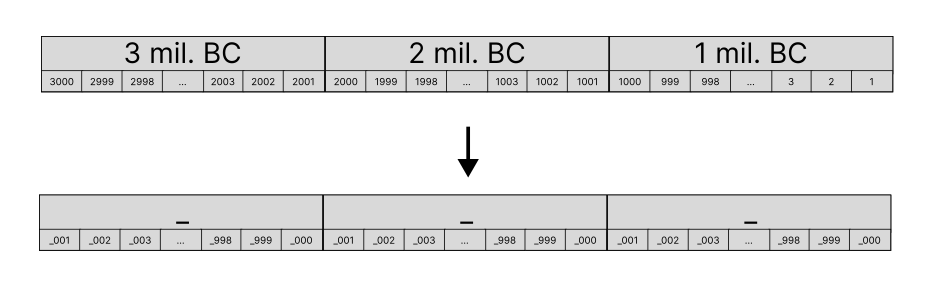
Notice how we don't yet know what how to number the millennia, and so there are underscores instead of numbers. Likewise, we don't yet know the first digits of year numbers, and so underscores are used there as well. But we know what the last 3 digits of each year are and that they will never change.
Big eras and the illusion of choice
How do we know that year numbers will have only 4 digits? Why not count from the Big Bang, for example?
Including absolutely all of the history of the universe in one era may seem aesthetically pleasing and the right thing to do. That is, until you think about it in practical terms.
What happens in practice if you use some big era? Well, for most of the history of the universe, using the new era won't change anything. Read some articles about dinosaurs. They don't use BC dates. Occasionally, they may use "ya" or "years ago," but mostly they use geological periods as time references.
On this site, I'm talking about programmatically replacing BC dates with something better. If there are no BC dates in the first place, then there is nothing to convert.
The only part of the timeline where you will actually see converted dates in electronic texts is history — some three millennia of history before Christ. To tell any two dates apart in that time period, you only need the last 4 digits of their year numbers. All digits to the left of the last 4 digits are just a prefix that will be exactly the same for all converted BC dates.
Let's look at some examples. Caesar died in 137999,9957 since the Big Bang. The first historical event — unification of Egypt — happened in 1379999,6900 since the Big Bang. But only the last parts — 9957 for the death of Caesar and 6900 for the unification of Egypt — are useful for telling those two dates apart. The first part — 1379999 — is just a useless prefix. It's actually harmful because it creates visual clutter and reduces readability.
But even if you choose to use some big era, my point is that your focus will always be on the last 4 digits of each year number. That's what I call the illusion of choice. It may seem that the choice of 10,000 BC as the starting point for the timeline is random and arbitrary because there are seemingly so many other options. But if you count from the Big Bang, or from the birth of planet Earth, or from any other similarly big era, you'll end up having to memorize the same 4-digit numbers that I use. It's all the same.
You are only free to choose one digit
We have determined that we really only need 4 digits to mark any year within history. And for each and every year, we know what the last 3 digits will be.
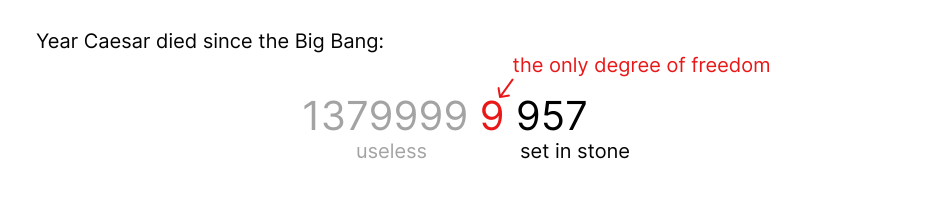
That means that you only need to choose one digit. Or, in other words, you need to decide how many millennia the new era (or the previous era) should contain.
How do you make this choice? This is where it becomes an opinion. Until now, we talked about the restrictions the necessity to convert dates in existing digital texts imposes on us. We have to reuse existing millennia, and we don't need to use more than 4 digits to tell apart any two dates within history.
However, when it comes to choosing the number of millennia, I can only share my opinion. You are free to disagree with it.
Don't be afraid
Before we talk about the number of millennia that should go into the new era, it is useful to note that making a mistake here is not scary at all. Why? Because we are talking about only one digit. You can learn entire ancient history in the system I propose, and later, if you decide I was wrong about the number of millennia, you'll be able to switch to a different system and readjust in a day or two. You won't have to re-learn all the dates from scratch.
Why 10 millennia (my opinion)
There are a few reasons. First of all, remember that we can't convert AD years for technical reasons. So there will be a restart of the year count at the beginning of the Common Era.
With the previous era containing exactly 10 millennia, we can say that we have used up all 4-digit numbers and had to restart the count after year 10,000 so that we don't have to use 5-digit numbers.
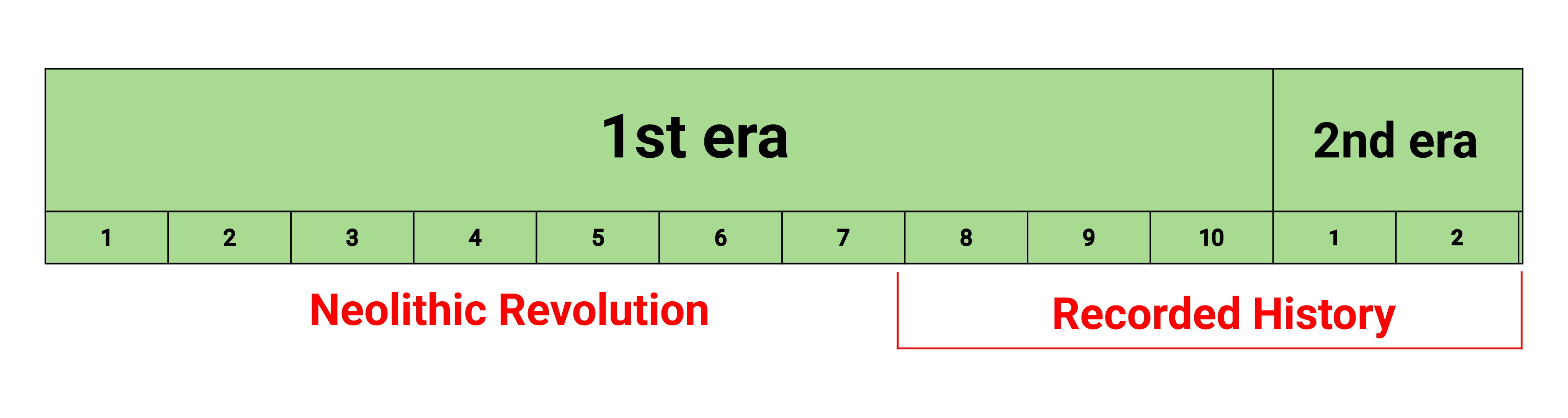
And we can imagine that this restarting of the year count may happen every 10,000 years.
Any other number of millennia would just look weird. Let's say you choose 4000 BC as the starting point:

Why would the count restart after just 4,000 years? Should it then restart every 4,000 years? It just looks weird. Why not use all 4-digit years before the restart?
The second reason is that it's actually good that the previous era is so big. History started late in that era: the first historical event — unification of Egypt — happened in 6900. Written history occupies a period 6900–10,000 in the previous era and 1–2000s in this era.
That means that for the next 5,000 years, you won't be able to confuse years of these two eras, and you don't need any special era notation. You'll just use numbers all the time. Very convenient.
Where you can start
If you want to try this new timeline, it helps to already know some key dates from ancient history. If you can name around twenty BC dates off the top of your head, you’re in a good position to feel the difference right away.
If not, that’s fine—you just need a bit of context first. A simple way to get it is to read Wikipedia for about 30 minutes a day over a few weeks. Focus on what happened, when, and where across the last three millennia before Christ. Don’t go deep—aim for a broad mental map of events.
Memorize a few dates to understand them all
Once you’re ready, install the extension and start reading with the new timeline.
As you go, pick a handful of major events and memorize their dates in the new system. Don’t translate them back to BC in your head—just let the new numbers stand on their own.
After a few days, it should start to click. Those memorized dates become reference points, and other dates begin to make sense relative to them.
A low-commitment experiment
In my experience, it takes about 4 days of reading Wikipedia for 30 minutes a day — 2 hours total.
That’s the entire commitment. If it doesn’t work for you, you’ve lost very little.
If it does, you’ll have a completely different way of experiencing history.
And if you ever change your mind about the starting point, just update it in the extension settings. Skim through a few Wikipedia articles, and you’ll readjust within a day or two. You won’t have to relearn dates from scratch.
Send me your feedback
If you get to the point where you can comfortably read and understand dates in the new timeline, I’d like to hear how it felt. Send me an email.